

Express Water 3-Stage Whole House Water Filter System

With over 380 customer ratings and a 4.6-star average, the Express Water 3-Stage Whole House system has a larger feedback base than almost anything else in this category at this price point. The free-standing stainless steel frame is a genuine differentiator: it does not require wall mounting, which matters in utility rooms with limited stud access, and the three built-in pressure gauges let you monitor filter condition at a glance rather than guessing when to swap cartridges. The contaminant list is broad, covering heavy metals, chloramine, chlorine, PFAs, lead, and arsenic, making it a credible choice for both well water with metal contamination and city water with disinfection byproducts.
The main trade-off is cost. At around $493, it is the priciest option in this guide, and replacement cartridges are an ongoing expense. Installation also requires plumbing work at the main water line, which is not a weekend project for most renters or first-time homeowners. For a family that owns its home and wants broad-spectrum protection at every tap, this is the most capable system on this list. If you are on city water only and your main concern is taste, a simpler under-sink unit would save you money.
For well water users in particular, the combination of sediment, carbon, and heavy-metal reduction stages addresses the most common problems in one housing unit. The stainless steel frame holds up in damp utility environments better than plastic housings over time. Given the review volume and the consistent positive feedback on build quality, this is the option we would recommend for homeowners who want a set-it-and-monitor solution for the whole house.
iSpring RCC7AK 6-Stage Reverse Osmosis System

NSF certification matters when you are choosing an RO system, because it means an independent third party has verified the filtration claims rather than relying solely on manufacturer data. The iSpring RCC7AK carries that certification and pairs it with a sixth alkaline remineralization stage, which adds back calcium and magnesium after the RO membrane strips them out. Pure RO water tastes flat to many people, and the remineralization stage is a practical fix that avoids buying a separate post-filter. At 75 gallons per day, the flow rate handles a typical household comfortably. The patented top-mounted faucet design is a small but real convenience: it makes filter changes easier because you do not have to reach around awkward plumbing to access cartridges.
The under-sink format means this system only filters water at one tap, so it is better suited for drinking and cooking than for whole-house use. For city water households that want near-total contaminant removal at the kitchen sink without spending $500 on a whole-house unit, this is the logical choice. Our guide to RO versus carbon filters covers the trade-offs between these two approaches in more detail.
The main practical considerations are storage space under the sink and the need for a small storage tank, both of which iSpring includes. Installation is doable for a confident DIYer with basic plumbing knowledge. The review count for this listing is low, which is worth noting, but NSF certification provides independent verification of the core performance claims that customer reviews cannot always offer.
3-Stage Whole House Water Filtration System
At $190 with two extra filter sets bundled in, this 3-stage system is the most accessible entry point for whole-house filtration on this list. It handles sediment, chlorine, and off-tastes, and the included extra cartridges soften the sting of the initial purchase since you are not immediately budgeting for replacements. The 1.5 to 2 year filter life claim is notably longer than most competitors quote, though actual life depends heavily on your water quality and household usage.
The 5.0-star rating on 14 reviews is promising but should be read with appropriate caution. A small sample size at a perfect score can shift quickly as more buyers weigh in. The 3/4-inch ports with two included valves make installation cleaner than units that require you to source your own fittings. It works for both well and city water according to the specs, though well water with heavy sediment loads will consume cartridges faster and may benefit from a dedicated sediment pre-filter upstream.
This is a sensible choice for budget-conscious homeowners who want whole-house filtration without the complexity or cost of the Express Water system. If your water quality issues are primarily chlorine taste and moderate sediment, it covers both. For heavier contamination problems like iron, hydrogen sulfide, or significant hardness, step up to the Express Water or add specialized pre-treatment stages.
GE RPWFE Refrigerator Water Filter

Refrigerator filters are often overlooked in filtration planning, but for households that primarily drink from the fridge dispenser, they do meaningful work. The GE RPWFE is a genuine OEM replacement, which matters because third-party fridge filters vary widely in actual performance. This one is certified to reduce lead, sulfur, and over 50 other impurities, and with 57 reviews at a 4.6-star average it has the most substantial feedback base among the fridge filters on this list.
The every-six-months replacement schedule is firm. Skipping it does not just reduce filtration efficiency; it can actually lead to bacterial growth in a saturated filter medium. At $50 per cartridge, the annual cost is $100, which is worth factoring into your budget. This filter is specifically for GE refrigerators using the RPWFE design, so confirm compatibility with your model before ordering.
For renters who cannot modify their plumbing or install under-sink systems, a refrigerator filter plus a countertop pitcher covers most drinking and cooking needs without requiring landlord approval. It is not a whole-house solution, but it is practical for situations where installation options are limited.
GE XWFE Refrigerator Water Filter

The GE XWFE is the same category as the RPWFE above: a genuine OEM refrigerator filter certified to reduce lead, sulfur, and over 50 impurities, priced identically at $50. The key distinction is refrigerator compatibility. The XWFE and RPWFE fit different GE refrigerator lines, so this one is not a duplicate recommendation. Check your refrigerator's manual or the existing filter label to confirm which design your model uses before purchasing either.
With 40 reviews at 4.5 stars, this has a reasonable feedback base, though slightly fewer ratings than the RPWFE. The six-month replacement schedule and the OEM status apply equally here. One practical note: GE built a chip into the XWFE housing specifically to prevent non-OEM filters from being recognized by the refrigerator, which has frustrated some buyers looking for cheaper third-party alternatives. If you own a compatible GE fridge, you are buying this filter.
Membrane Solutions 5-Micron String Wound Sediment Cartridges (6-Pack)

If you are on well water, sediment filtration is often the first line of defense before any carbon or RO stage. String wound cartridges like these trap sand, silt, rust, and fine particulates that would otherwise clog or damage downstream filters and appliances. At $33 for a 6-pack, these are priced well below single-cartridge alternatives, and the 5-micron rating catches particles that many basic filters miss. The 4.7-star rating is encouraging, though it comes from only 4 reviews, so treat it accordingly.
These cartridges fit the standard 10" x 2.5" housing used in many whole-house pre-filter setups, making them a practical replacement option for several popular systems. Well water users with high sediment loads often burn through sediment cartridges faster than carbon stages, so buying in bulk makes more financial sense than purchasing singles. If you want even finer pre-filtration before an RO system, the ICEPURE 1-micron cartridges reviewed below provide a tighter cut. For general well water sediment management, 5 micron is the right starting point for most properties. Our roundup of well water sediment filter cartridges covers more options in this category.
PUREPLUS 5-Micron 10" x 4.5" Whole House Sediment and Carbon Cartridges (2-Pack)
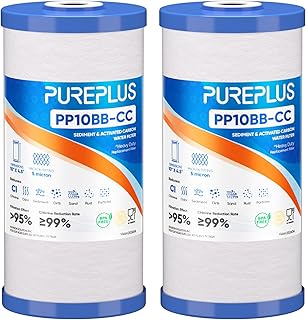
The 10" x 4.5" (big blue) housing format is larger than the standard 2.5" diameter used in most countertop setups, and it is common in older GE and Culligan whole-house systems. The PUREPLUS 2-pack covers both sediment and carbon filtration in a single cartridge, reducing the number of separate housings needed. At under $28 for two cartridges, this is priced well compared to OEM replacements for compatible systems.
The compatibility list is extensive: GE FXHTC, GXWH40L, GXWH35F, GNWH38S, Culligan RFC-BBSA, WRC25HD, Pentek RFC-BB, and several others. If your existing housing matches any of these, this is a practical maintenance purchase. With 7 reviews at 4.7 stars the feedback is limited, so this is a reasonable buy for confirmed-compatible systems but not a product to stake a new installation on. For new whole-house setups, the complete 3-stage systems reviewed above offer more comprehensive filtration out of the box.
ICEPURE 1-Micron CTO Carbon Sediment Cartridges (4-Pack)

At 1 micron, these ICEPURE cartridges filter finer than the 5-micron options above, making them a useful pre-filter before an RO membrane or in situations where very fine sediment is a problem. The CTO designation means they handle chlorine taste and odor as well as sediment, combining two functions in one relatively affordable cartridge. A 4-pack for $27 works out to under $7 per cartridge, which is competitive for carbon-sediment combination filters.
The compatibility list covers DuPont housings, the FXWTC, and standard RO pre-filter positions. For anyone running the iSpring RCC7AK reviewed above or similar RO systems, 1-micron pre-filtration at this price point is a practical maintenance choice. The review base of 6 ratings is the smallest on this list, so these should be considered a functional, value-priced consumable rather than a thoroughly validated product. For a broader look at how different filter types work together, the filter type explainer covers the mechanics of carbon, sediment, and RO stages in detail.
How to Choose the Right Water Filter for Your Home
Start With a Water Test, Not a Filter
The single most useful thing you can do before buying any filter is test your water. City water utilities are required to publish annual Consumer Confidence Reports (CCRs), which list detected contaminants and their levels. You can find yours at the EPA's drinking water website using your zip code. Well water has no such reporting requirement, so if you are on a private well, you need to test yourself. Basic test kits are available for under $30 and check for common issues like bacteria, nitrates, hardness, and pH. For a more thorough picture of metals and organics, a certified lab test through a service like National Testing Laboratories runs around $100 to $200 and gives you a complete contaminant profile. Buying a filter before you know what is in your water is a common mistake. A carbon filter does nothing for arsenic; an RO system does nothing for bacteria; a sediment filter does nothing for chlorine. Knowing your water first means you are solving the actual problem rather than guessing.
Understand the Four Main Filter Types
Sediment filters catch physical particles: sand, silt, rust, and debris. They are measured in microns, where a lower number catches finer particles. They do not address chemical or biological contaminants and are usually used as a first stage before other filters. Carbon filters (including carbon block and granular activated carbon) are best at removing chlorine, chloramines, volatile organic compounds (VOCs), and off-tastes and odors. They are the standard technology in pitcher filters, fridge filters, and most under-sink single-stage systems. Reverse osmosis (RO) systems push water through a semi-permeable membrane that rejects dissolved solids, heavy metals, nitrates, fluoride, and many other contaminants that carbon cannot touch. They waste some water in the process and filter slowly, so they are typically used as point-of-use systems at one tap. UV filters use ultraviolet light to neutralize bacteria and viruses; they do not remove any particles or chemicals, so they are used in combination with other stages, particularly in well water systems where biological contamination is a concern. Our full explainer on filter types goes deeper on how each technology works and when to use it.
Well Water vs. City Water: Different Problems, Different Solutions
City water is treated by the utility before it reaches your home, which means biological contamination and heavy sediment are rarely concerns. The typical city water problems are chlorine taste and smell (a byproduct of disinfection), chloramines (used as an alternative disinfectant in many municipalities), trace pharmaceuticals, and occasionally lead from aging service lines or in-home plumbing. A quality carbon filter or an under-sink RO system addresses most of these. Well water is untreated, so the contamination picture is completely different. Iron and manganese cause staining and metallic taste. Hydrogen sulfide produces a rotten egg smell. High sediment loads from nearby soil conditions wear out appliances and can clog downstream filters. Bacteria and nitrates from agricultural runoff or septic proximity are common in certain regions. High hardness causes scale buildup. For well water, the typical recommendation is a multi-stage approach: sediment pre-filter first, then a specific stage targeting your confirmed contaminants (iron filter, carbon, or RO), and UV treatment if biological contamination is present or suspected. For a look at whole-house systems specifically designed for well water, the whole-house filtration roundup covers the main options.
Point of Entry vs. Point of Use
A point-of-entry (POE) system installs where the main water line enters your home and treats all water throughout the house: every tap, shower, toilet, and appliance. Whole-house systems like the Express Water 3-Stage and the 3-Stage budget system reviewed above are POE systems. They are best when you want to protect appliances from scale and sediment, eliminate chlorine skin and hair effects from showering, or address well water contaminants at the source. A point-of-use (POU) system treats water at a single tap. Under-sink RO systems, fridge filters, and countertop units are all POU systems. They deliver higher filtration performance per dollar at one location but do nothing for the rest of the house. For most city water households where the primary goal is better-tasting drinking water, a POU system is the more cost-effective choice. For well water, a POE sediment and carbon pre-treatment combination followed by a POU RO system for drinking water is a common and practical approach.
Factor in Ongoing Costs, Not Just Purchase Price
The sticker price of a filter system is only part of the actual cost. Replacement cartridges, filter frequency, and water waste (for RO systems) determine the real long-term expense. A $50 refrigerator filter replaced every six months costs $100 per year indefinitely. A whole-house system with $80 in annual cartridge costs may be far cheaper over five years than it appears upfront. Check the manufacturer's recommended replacement interval and the price of replacement cartridges before committing to any system. Also consider the realistic maintenance burden: cartridges that are hard to find, expensive, or require a plumber to change will often get skipped, which undermines the whole point. The products in this guide that come with extra cartridge sets (like the budget 3-stage whole-house system) reduce this friction meaningfully in the first year or two.
Frequently Asked Questions
It is strongly recommended. City water users can start with the free Consumer Confidence Report published by their utility, which lists detected contaminants. Well water users should order a lab test, since private wells have no reporting requirements. Without knowing what is in your water, you risk buying a filter that does not address your actual problem. Basic home test kits are available for under $30; comprehensive lab tests run around $100 to $200.
A whole-house (point-of-entry) filter treats all water coming into your home, protecting every tap, shower, and appliance. An under-sink (point-of-use) filter treats water at one tap only, typically delivering higher filtration performance at that location for a lower cost. For well water with sediment or iron issues, a whole-house approach makes more sense. For city water households that mainly want better-tasting drinking water, an under-sink filter is usually more practical and economical.
Yes, with the right type. Refrigerator filters and countertop filters require no plumbing modifications and are fine in rental situations. Under-sink filters typically require connecting to the existing cold water line, which most landlords will permit since the modification is reversible, but checking your lease is a good idea. Whole-house systems require cutting into the main water line, which almost always needs landlord approval and is typically not worth pursuing in a rental.
Follow the manufacturer's schedule as a starting point, then adjust based on your actual water quality and household usage. In high-sediment well water, cartridges can exhaust in weeks rather than months. In low-contaminant city water, some filters last longer than the stated schedule. A pressure gauge before and after a whole-house filter housing shows when flow restriction signals it is time to replace. For refrigerator and under-sink filters, the indicator light in the system is a reasonable guide, though manufacturers tend to err on the conservative side.
RO membranes reject most dissolved solids, which includes contaminants like lead, arsenic, nitrates, and fluoride, but also beneficial minerals like calcium and magnesium. This is why systems like the iSpring RCC7AK include a remineralization stage after the RO membrane. If your RO system does not have remineralization, the water will taste flat and will be slightly more acidic. It is safe to drink, but many people find remineralized RO water more palatable.