

PRO+AQUA Elite Series GEN2 PRO-100-E 3-Stage Whole House Water Filtration System

The PRO+AQUA Elite GEN2 earns the top spot through a combination of solid specs, broad water source compatibility, and the largest verified buyer review base of any 3-stage system in this roundup. At 495 ratings averaging 4.6 stars, there is genuine confidence behind that number, unlike several competing systems with very limited review counts. The 1" inlet and outlet ports keep flow rates high enough for 3 to 4 bathroom homes without noticeable pressure loss, which is a meaningful advantage over budget systems using 3/4" ports. Built-in pressure gauges let you monitor filter condition visually: a dropping outlet pressure reading tells you the filters need changing before your water quality degrades.
The three filtration stages target sediment, chemicals, heavy metals, and other contaminants in sequence. The system works on both city and well water, which makes it more versatile than systems tuned for one source type. Buyers consistently note that installation is manageable with basic plumbing skills, though anyone not comfortable cutting into a main supply line should budget for a licensed plumber. The 1" ports require 1" supply lines, so homes with 3/4" plumbing will need adapters, which adds a small cost but does not affect long-term performance.
For a household wanting broad whole-home filtration without paying premium pricing or dealing with softener salt and complex installation, this is the most balanced choice available. The combination of genuine buyer feedback, 1" ports, pressure gauges, and city-and-well compatibility makes it the benchmark against which the other systems in this list are measured. Our full buyer's guide covers how to match a system like this to your specific water test results.
Express Water 3-Stage Whole House Water Filter System

If your water test has flagged elevated heavy metals, PFAs, lead, or arsenic, this Express Water system justifies its higher price over general-purpose 3-stage alternatives. The explicit targeting of PFAs and arsenic in the filter media is a real differentiator at this price point; most mid-range whole house systems focus on sediment and chlorine and leave those specific contaminants largely untouched. Three dedicated pressure gauges, one per filter housing, allow you to track the performance of each stage independently, which is more diagnostic than a single gauge covering the whole system.
The free-standing stainless steel frame is a practical distinction from wall-mounted setups. In a basement or utility room where wall space is limited, concrete walls make anchoring difficult, or you simply want flexibility to reposition the unit, the floor-standing frame eliminates those constraints. With 386 ratings at 4.6 stars, the feedback base is substantial enough to treat as reliable signal. Buyers report the stainless frame is solid and the filter housings maintain a consistent seal over time.
The roughly $50 premium over the PRO+AQUA is justified when your water test shows specific heavy metal or PFAs concerns. If your water issues are primarily chlorine taste and general sediment, the PRO+AQUA covers those at a lower price with a larger review base. Read our explainer on what each filter type actually does to understand which stages address which contaminants before deciding whether the heavy metal targeting is relevant to your situation.
Aquasure 64,000 Grain Whole House Water Softener and 75 GPD RO Bundle

The Aquasure bundle takes a fundamentally different approach from the other systems here: it combines a 64,000-grain ion-exchange water softener with a 75-GPD reverse osmosis drinking water system. That is a whole-home hard water solution plus high-purity drinking water in a single purchase. The 64,000-grain capacity is rated for households with 4 to 6 or more bathrooms. The automatic digital metered control regenerates the softener based on actual water usage rather than a fixed timer, which uses less salt and water than older timer-based designs.
The RO component produces 75 gallons per day of filtered drinking water, which is enough for a busy household without running short. Softener systems work through ion exchange, replacing calcium and magnesium with sodium, so households with sodium-restricted dietary requirements typically use a separate RO tap for drinking water. This bundle addresses that need directly by including both components. The 288 ratings at 4.5 stars provide reasonable confidence in the package.
The trade-offs are significant: this is the most expensive system in the roundup at $859.99, it requires ongoing salt purchases for the softener regeneration cycle, and installation is substantially more complex than mounting a standard filter housing. The softener component involves a drain line connection and electrical connection for the control head. Many buyers will want professional installation, which adds to the total cost. This bundle makes sense for households with confirmed hard water issues and the budget and space to support a multi-component system.
iSpring WGB32BM 3-Stage Whole House Iron and Manganese Filter
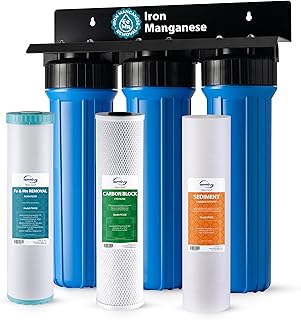
Iron and manganese are among the most common well water problems in the United States. They stain fixtures orange and brown, leave metallic tastes in water, and cause long-term buildup in appliances and pipes. Most standard whole house filters handle sediment and chlorine effectively but do little for dissolved iron, which requires specific filter media to address. The iSpring WGB32BM is built specifically around this problem: its three stages target iron and manganese removal alongside standard sediment and chlorine filtration.
iSpring is a well-established water filtration brand with broad product availability and accessible aftermarket filter support. The system uses a big blue housing format common across the industry, which means you are not locked into iSpring's own branded replacement cartridges if third-party alternatives are less expensive. The 4.6-star rating reflects strong feedback from iSpring's customer base, though the verified review count for this specific model in our dataset is limited, so that rating should be interpreted with some caution rather than at face value.
At $473.68, it lands close to the PRO+AQUA Elite GEN2, so the decision comes down to your water test results. Confirmed elevated iron or manganese makes this the more targeted and appropriate choice. If your water issues are primarily chlorine and general sediment with no iron concerns, the PRO+AQUA covers those needs at a similar price with a substantially larger verified review base. See our well water filtration guide for more on addressing iron and sediment from private well sources.
Express Water Whole House Water Filter System (Ultimate Protection)

Express Water's Ultimate Protection system sits at the premium end of their lineup, adding dedicated anti-scale filtration on top of the heavy metal and contaminant reduction found in their standard 3-stage model. Scale buildup from hard water is a genuine long-term problem for water heaters, washing machines, and dishwashers. Whole-house scale reduction addresses this at the source without requiring a full ion-exchange water softener, which adds sodium to the water and requires ongoing salt maintenance. If you are in a hard water area and want appliance protection without a softener, this is a practical alternative.
The 96 ratings at 4.5 stars provide some confidence, but it is a smaller feedback pool than either the standard Express Water 3-stage or the PRO+AQUA, so the rating carries less weight than those options. The contaminant targeting is largely similar to the lower-cost Express Water 3-stage model; the key addition is the anti-scale media in the third housing. That is the primary justification for the roughly $155 premium over the standard Express Water 3-stage.
The honest calculation: for households with confirmed hard water and documented scale problems, the anti-scale stage adds real value in appliance protection over time. For households where scale is not a known issue, the premium is difficult to justify given the similar contaminant reduction profile of the standard 3-stage model at a lower price. Check a water hardness test before spending up to this tier.
3-Stage Whole House Water Filtration System with Extra Filter Sets
This 3-stage system stands out in the budget tier primarily because the purchase price includes two complete sets of replacement filters. That bundling changes the actual value calculation significantly: if replacement filter sets run $30 to $50 each, the included extras represent meaningful real savings on top of the $189.99 sticker price. The stated 1.5 to 2 year filter life per set is also longer than many whole house systems, which often call for replacement every 3 to 6 months. Two included shut-off valves simplify the installation and future filter changes without hunting down separate hardware.
The 5.0-star rating is notable, but it is based on only 14 reviews. That sample size is too small to treat with confidence. Early ratings on newer product listings tend to skew optimistic before a broader range of buyers weigh in. The 3/4" ports fit standard residential plumbing in most homes without adapters, which simplifies installation, though households with high simultaneous water demand across multiple fixtures may notice more pressure reduction than a 1" port system would produce.
This system fits city water households who know their issues are primarily chlorine taste and basic sediment, and who want to minimize both upfront cost and near-term filter replacement spending. Well water users, or anyone with confirmed contamination beyond sediment and chlorine, should look at the more specialized systems higher in this list. The included replacement filter sets are the real selling point here; without them, the price advantage over the iSpring WGB21B narrows considerably.
iSpring WGB21B 2-Stage Whole House Water Filtration System

The iSpring WGB21B is the most affordable fully functional whole house filter in this roundup. Two stages cover the essentials: a sediment filter followed by a CTO carbon block filter that handles chlorine, taste, and odor. That combination addresses the most common complaints about municipal water without the cost or complexity of a 3-stage system. The 1" inlet and outlet ports are a genuine advantage at this price point, as they maintain better flow rates than the 3/4" ports found on cheaper alternatives.
iSpring uses the 10" x 4.5" big blue housing standard for both filter stages, which is widely available from multiple filter manufacturers. This matters because you are not locked into iSpring's own branded cartridges; third-party replacements are easy to source and frequently less expensive. iSpring has a solid track record in the water filtration space and accessible customer support. The 4.6-star rating reflects the brand's broader reputation, though the verified review count for this specific model listing is limited in our dataset, which warrants some caution.
This is the practical choice for households who want a legitimate whole house filter without crossing into mid-range pricing, and whose water test results show only chlorine and sediment issues. It will not address iron, heavy metals, or PFAs, so a water test first is essential. If results show only the basics, the WGB21B delivers reliable performance from a known brand at a strong price. Our guide to water filters under $100 covers additional options if even this price point is outside your budget.
GE GXWH20T Whole House Water Filtration System
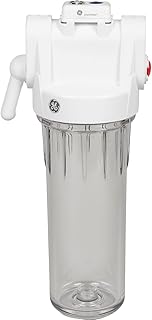
The GE GXWH20T is a filter housing, not a complete filtration system. The $39.86 price gets you the housing unit, mounting hardware, and installation accessories. The filter cartridge is sold separately and GE recommends replacing it every 3 months, which is a more frequent maintenance schedule than any other system in this roundup. Factor that ongoing cartridge cost into your actual budget before treating this as the inexpensive option. The compatible filter list covers GE's FXWTC, FXUSC, FXWPC, and FXWSC cartridges, all of which address sediment and rust but do not help with chlorine, heavy metals, or taste and odor.
Where this makes sense is as a true entry point for a household that needs only basic sediment and rust removal, or as a first filtration stage ahead of a more capable under-sink or point-of-use system. The 386 ratings at 4.5 stars from GE's established customer base give genuine confidence that the housing does its basic job reliably without leaks or fit issues. GE's wide retail distribution means replacement cartridges are available at hardware stores and home improvement retailers, not just online.
Be clear about what this unit does not do: it will not reduce chlorine or improve taste, it will not address hard water, and it does not touch heavy metals or organic compounds. If your goal is meaningfully better water quality rather than basic rust and sediment protection, the iSpring WGB21B at $155.99 is a far more complete solution and worth the additional spend for most households.
How to Choose a Whole House Water Filtration System
Test Your Water Before Buying
The most common and costly mistake when buying a whole house filter is choosing based on marketing claims rather than actual water chemistry. A basic water test, available as a mail-in kit from several retailers or sometimes free through your municipal water supplier, tells you what you are actually dealing with. If results show only chlorine and sediment, a 2-stage system like the iSpring WGB21B covers you at $156. If you have elevated iron or manganese, you need iron-specific filter media. If results show PFAs, lead, or arsenic, you need targeted heavy metal filtration. Buying a $650 premium system when your water needs only basic sediment filtration wastes money. Buying a cheap sediment filter when you have heavy metals in your water is a serious mistake in the other direction. Our full buyer's guide walks through the water testing process in detail.
Number of Filtration Stages
Single-stage systems like the GE GXWH20T handle only sediment and rust. Two-stage systems add a carbon block filter that reduces chlorine, taste, and odor. Three-stage systems add a third housing for more targeted treatment: additional carbon media, iron reduction, heavy metal filtration, or anti-scale media depending on the model. More stages provide broader protection, but each stage also adds flow resistance and ongoing maintenance cost. Match the stage count to what your water test actually shows you need rather than defaulting to the most stages available.
Port Size and Flow Rate
The inlet and outlet port size determines how much water can pass through the system before you notice pressure loss. Systems with 1" ports, including the PRO+AQUA Elite GEN2, iSpring WGB21B, and both Express Water models, maintain better flow rates for homes with multiple bathrooms and high simultaneous water demand. Systems with 3/4" ports fit most standard residential plumbing directly but can cause pressure reduction in larger homes. Check your existing supply line diameter before ordering; adding reducers to bridge a size mismatch adds cost and can restrict flow further.
Filter Life and Ongoing Maintenance Costs
The purchase price covers only part of the real cost. Replacement filter cartridges for whole house systems typically run $20 to $80 per stage depending on filter type and brand, and replacement frequency ranges from 3 months for basic sediment housings to 6 to 12 months for most carbon filters, to 1 to 2 years for some specialty media. Calculate the annual filter cost for any system you are considering. Systems using standard big blue housing formats, common in 10"x4.5" and 10"x2.5" sizes, accept third-party cartridges at lower cost. Systems using proprietary cartridges limit your sourcing options and can cost more over time.
Installation Complexity
Every whole house filter requires cutting into your main supply line, shutting off main water, and making two watertight connections with correct fittings. For standard 3-stage filter housing systems, a homeowner with basic plumbing skills can typically complete the installation in 2 to 4 hours. The Aquasure softener bundle is a significant exception: it involves multiple separate components, a drain line connection for the softener regeneration cycle, and an electrical connection for the digital control head. Professional installation is worth budgeting for that system. Verify port size compatibility with your supply line and confirm you have adequate space in your utility room or basement before placing an order.
Frequently Asked Questions
It depends on the filter type and the system. Basic sediment pre-filters typically need replacement every 3 to 6 months. Carbon block filters for chlorine and taste reduction generally last 6 to 12 months. Some specialty media like iron reduction or anti-scale filters can last 1 to 2 years. If your system includes pressure gauges, a noticeable drop in outlet pressure is usually the most reliable indicator that a filter change is overdue regardless of the calendar schedule.
For standard 3-stage filter housing systems, yes, if you are comfortable with basic plumbing. The job requires cutting the main supply line, making two threaded or push-fit connections, and securing the filter housing in place. Most installs take 2 to 4 hours with the right tools. For any system with a water softener, drain line, or electrical control component, professional installation is the safer and strongly recommended choice.
A water filter removes contaminants through physical filtration or adsorption, targeting particles, chlorine, heavy metals, and organic compounds. A water softener removes hardness minerals, specifically calcium and magnesium, through ion exchange, replacing them with sodium. Softeners address scale buildup and hard water effects on appliances and skin but do not remove other contaminants. The Aquasure bundle in this roundup combines both functions, which is why it costs significantly more than filter-only systems.
Any filter introduces some resistance, so a small amount of pressure reduction is normal. Systems with 1" ports and filters changed on schedule maintain pressure well in most residential situations. Filters that are overdue for replacement cause progressively worse pressure loss as they clog. If you notice a meaningful drop in pressure at faucets or showers, it is usually a sign that one or more filter cartridges need replacing rather than a problem with the system itself.
Municipal water meets federal safety standards, but treatment typically includes chlorine or chloramine additions that affect taste and odor. Water quality can also vary based on local distribution infrastructure, particularly in older homes with aging pipes. A whole house filter primarily addresses taste, odor, and sediment picked up in distribution. If a water test shows specific concerns like lead from older plumbing or PFAs, a targeted whole house system adds meaningful protection even on treated city water.