
KINETICO K5 Reverse Osmosis Taste Odor 9306B + Carbon Sediment Filter 9461A Cartridge

The Kinetico K5 is one of the more capable multi-stage RO systems on the market, and these OEM-spec replacement cartridges are what keep it running properly. The bundle covers two critical stages: the 9306B taste and odor cartridge handles post-RO polishing to remove any residual chlorine or off-flavors, while the 9461A carbon sediment cartridge protects the RO membrane by capturing particulates and chlorine before the water reaches the membrane stage. With 244 reviews averaging 4.5 stars, there is enough purchase history to take the quality claims seriously.
The main limitation here is compatibility. These cartridges are engineered specifically for the Kinetico K5 system, so if you own a different brand of RO unit, this listing is not for you. The $192.98 price is also a real consideration. It is what premium OEM RO maintenance costs, and it reflects the quality of the components rather than padding. If you are maintaining a K5, using off-brand cartridges to save money risks voiding the system warranty and potentially compromising membrane life, so the price is largely justified.
For K5 owners, this is simply the correct replacement set to buy. For anyone still shopping for an RO system, the ongoing cartridge cost at this price point is a factor worth building into your total cost of ownership before purchasing a K5 in the first place.
Express Water 10 Pack Activated Carbon Block ACB Water Filter Replacement, 5 Micron, 10 Inch

With 760 reviews at 4.6 stars, this is the most widely reviewed product in this roundup, and that purchase history matters. These 5-micron activated carbon block filters fit standard 10-inch under-sink housings and are also used as the carbon pre-stage or post-stage in many RO systems. The carbon block format is more effective than granular carbon at holding contact time with the water, which means better chlorine and organic compound reduction.
The value proposition is straightforward. At about $5.80 per filter when bought as a 10-pack, you are getting a year or more of filtered water coverage at a price that beats most of the single-filter options on the market. The 5-micron rating means it handles sediment reasonably well while also adsorbing taste and odor compounds. If you have a multi-stage under-sink system, replacing the carbon stage with these is a sensible budget move.
The limitation worth noting is that 5-micron carbon filtration is not a complete water treatment solution on its own. It will not reduce nitrates, heavy metals beyond surface-level adsorption, or TDS. For city water with chlorination issues or aesthetic taste problems, it does the job well. For well water or water with chemical contamination concerns, carbon alone is not enough, and a full RO system should be on your list.
Hydronix ICF-10 Inline Post Activated Carbon Water Filter, 1/4-Inch NPT, 2000 Gallons, 3 Pack
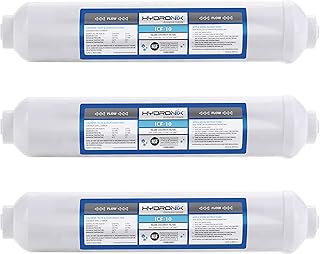
The Hydronix ICF-10 occupies a specific and useful niche: the final carbon polishing stage after an RO membrane, or as a direct inline filter for a refrigerator or ice maker. With 382 reviews at 4.6 stars, it has enough field use to confirm it performs consistently. The 2000-gallon capacity per filter translates to roughly one year of typical household use before replacement, and the 3-pack format covers approximately three years of maintenance in one purchase.
The 1/4-inch NPT connection is standard for most RO post-filter stages and refrigerator lines, which keeps installation simple. The inline design means there is no housing to manage or open; when the filter hits its service life, you simply cut the tubing, swap in a new cartridge, and reconnect. For RO system owners, this type of post-filter is important because even after the membrane removes the bulk of contaminants, water stored in a pressure tank can pick up a flat taste; the carbon post-stage restores the palatability.
The primary constraint is that this is a post-filter, not a primary treatment device. It polishes already-filtered water. Using it as the only filtration stage on a direct tap line would be inadequate for anything beyond basic taste improvement. Pairing it correctly, either after an RO system or on a refrigerator line fed by treated water, is where it earns its rating.
APEC Water Systems FILTER-SET-ES High Capacity Replacement Pre-Filter Set, Stages 1-3

APEC is one of the better-known RO system brands in the residential market, and this replacement set covers the first three stages of their Essence series: sediment removal in stage 1, followed by two carbon block stages that strip chlorine, chloramines, and organic compounds before water reaches the RO membrane. Protecting the membrane from chlorine and sediment exposure is the whole purpose of pre-filters, and replacing them on schedule is what keeps membrane life from being cut short.
At $25.45 for a three-stage set, the per-filter cost is reasonable for APEC-compatible components. The 4.7-star rating is promising, though the review count is only 5 at time of writing, which is a genuine limitation for drawing conclusions about long-term reliability. For APEC Essence owners, this is the manufacturer-recommended replacement approach. Using third-party filters sized for the same housing is an option, but fit tolerances and media quality can vary enough to make the OEM set worth the modest premium.
The main caveat is compatibility. This set works specifically with the Essence series; APEC makes other product lines that use different filter sizes. Confirming your system model before ordering is important. If you own an Essence-series unit and are due for a pre-filter change, this is a clean, affordable solution.
APEC Water Systems 10" Carbon Block Water Filter for Reverse Osmosis System, 10 Micron (FI-ES-CAB10)

At $10.80 for a single filter with 100 reviews at 4.6 stars, this APEC carbon block is one of the most accessible entry points in the category. The 10-micron rating means it captures larger particles and handles chlorine adsorption effectively, though it is less fine than the 1-micron and 5-micron options also in this roundup. For an RO system pre-stage where the membrane will handle deeper filtration downstream, 10 micron is often adequate.
The 10-inch by 2.5-inch standard sizing means it fits a wide range of filter housings beyond just APEC systems. If you have a generic under-sink housing and want a reliable carbon block at a low per-filter cost, this is a sensible option. Where it starts to underperform is as the sole filter in a whole-house or point-of-use system where you need finer sediment control; a 1-micron or 5-micron block would be better suited for those applications.
This is a good filter to keep on hand as a replacement for the carbon stage in an RO system, especially if you want to maintain a manufacturer like APEC without spending more than necessary. The value is clear; the compromise is micron rating and the fact that a single filter purchase gives no volume discount.
ERO 5-Stage Reverse Osmosis Filters Yearly Set, Compatible with Most 10" RO Systems, Filter Wrench Included

The ERO yearly set covers all five stages of a standard RO system in one purchase: sediment pre-filter, carbon block stages, RO membrane, and a post-carbon polishing filter. For someone who wants to do one annual maintenance order rather than sourcing individual filters separately, the convenience argument is real. The included filter wrench is a practical addition; the housing wrenches that come with most RO systems get lost quickly, and having one bundled in is useful.
The core concern with this product is the review count. One review at time of writing means there is almost no purchase history to draw on. The compatibility claim of fitting most standard 10-inch RO systems is consistent with how universal those dimensions are in the market, but without more user feedback confirming fit and performance across different system brands, some uncertainty remains. The $66.99 price for five filters works out to about $13.40 per stage, which is reasonable if quality holds.
This is a product worth considering if the all-in-one convenience fits your approach to maintenance, but given the limited review history it sits behind the more established options in this roundup. If you can confirm compatibility with your specific system model before ordering, the value proposition is solid.
ICEPURE 1 Micron 2.5" x 10" Whole House CTO Carbon Sediment Water Filter Cartridge, Pack of 4

The ICEPURE CTO filter earns its place here primarily on the strength of its 1-micron rating and wide compatibility list. At 1 micron, it captures fine sediment particles alongside chlorine, taste, and odor compounds, making it finer than several more expensive options in this roundup. The 4-pack format at $26.99 brings the per-filter cost to about $6.75, which is reasonable for a 1-micron carbon sediment cartridge. Compatibility covers a broad range of DuPont housings as well as RO pre-stages.
The limitation that keeps this product ranked seventh is its review count of 6. A 4.6-star average from 6 purchases tells you almost nothing about how these filters perform over time, whether the 1-micron claim holds under pressure, or how flow rate compares to competing products. The compatibility list is long, which is either a sign of genuinely broad design tolerances or optimistic marketing; without more buyer feedback, it is difficult to say with confidence.
For whole-house CTO applications where you need a fine-micron carbon sediment cartridge on a budget, this is worth considering. Go in with the understanding that the limited review history means you are taking a small risk on a product with unconfirmed long-term performance, and check the filter housing dimensions carefully before ordering.
How to Choose Between RO and Carbon Filtration
Start With a Water Quality Report
Before buying any filter, find out what is actually in your water. If you are on municipal water, your utility is required to publish an annual Consumer Confidence Report. If you are on a private well, a lab test is the only way to know what you are dealing with. The results will tell you whether you are facing a taste and aesthetic problem (carbon handles that) or a chemical contamination problem requiring an RO system. Buying a more expensive system than your water actually requires is a common mistake.
What Carbon Filters Remove (and What They Do Not)
Activated carbon, particularly carbon block formats rated at 5 microns or finer, is effective at removing chlorine, chloramines, volatile organic compounds (VOCs), and many pesticides. It also improves taste and odor noticeably. What carbon does not do is reduce total dissolved solids, remove nitrates, kill bacteria, or meaningfully reduce heavy metals beyond trace surface adsorption. For most city water users whose primary complaint is flat or chemical-tasting water, carbon filtration is sufficient and far cheaper to maintain than an RO system.
What Reverse Osmosis Systems Remove
An RO membrane filters water at the 0.0001-micron level, which means it physically blocks dissolved salts, heavy metals, nitrates, fluoride, arsenic, bacteria, and viruses that carbon cannot touch. This is why RO systems are the recommended approach for well water users, households with documented lead or nitrate issues, or anyone looking to significantly reduce TDS readings. The tradeoff is water waste (typically 2-4 gallons of reject water per gallon of filtered output), slower flow rates, and higher maintenance costs because RO systems use 4-6 filter stages that each need periodic replacement.
Understanding Multi-Stage Systems and Carbon's Role in RO
Most under-sink RO systems use carbon at multiple stages. Carbon pre-filters protect the RO membrane from chlorine damage, which can degrade membrane performance quickly without pre-treatment. A carbon post-filter then polishes the water after the storage tank to restore taste before it reaches your tap. This means if you own an RO system, you are already using carbon filtration as part of the process. The pre-filter cartridges from Express Water and APEC reviewed above are examples of how carbon and RO work together rather than as competing choices.
Annual Maintenance Costs Are More Important Than Upfront Price
A carbon under-sink filter with a single housing and one replacement cartridge per year might cost $30-$60 annually to maintain. A five-stage RO system could cost $60-$150 per year depending on the brand and how often you replace each stage. The membrane itself typically lasts 2-3 years, but the pre- and post-carbon stages need annual replacement. Build these ongoing costs into any purchase decision. A cheaper system with expensive proprietary cartridges can end up costing more over five years than a premium system with standard 10-inch filter compatibility.
Frequently Asked Questions
Standard activated carbon filters do not remove fluoride. Fluoride is a dissolved ion, not an organic compound, so it passes through carbon media largely unaffected. If fluoride reduction is a priority, an RO system with a semi-permeable membrane is the correct tool; RO systems can reduce fluoride by roughly 85-95% depending on membrane quality and water chemistry.
For most people on properly treated municipal water, a quality carbon block filter is enough to improve taste, remove chlorine, and address most aesthetic concerns. An RO system becomes worth considering if your Consumer Confidence Report shows elevated lead, nitrates, or other dissolved contaminants, or if you have a specific health reason to reduce TDS. Running your tap water through a TDS meter is a simple first check; readings consistently above 300-400 ppm often warrant RO consideration.
Most manufacturers recommend every 6-12 months for residential use, though actual replacement frequency depends on your water quality and usage volume. Cartridges in areas with high sediment or high chlorine loads will exhaust sooner. A consistent drop in flow rate or the return of chlorine taste are practical signs that a cartridge needs replacement regardless of the calendar.
Yes. RO water is safe to drink. The concern sometimes raised is that RO removes beneficial minerals like calcium and magnesium along with contaminants. While that is true, dietary minerals come primarily from food rather than water, so the contribution from drinking water is minor for most people. If mineral content matters to you, remineralization filters are available as an add-on stage for most RO systems.
Yes, and you should. Most RO systems include a carbon post-filter stage already, but if yours does not, adding an inline carbon filter like the Hydronix ICF-10 between the pressure tank outlet and your tap faucet is a straightforward upgrade. It polishes out any flat or stale taste that water can develop from sitting in the storage tank, and the inline design makes installation simple.