

Express Water 1 Year RO Filter Set (11 Filters, 100 GPD + UV)
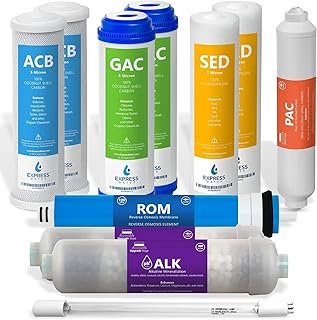
This kit earns the top spot because it covers all four filter technologies in a single purchase. You get sediment filters to catch particles, multiple activated carbon stages (GAC for chlorine and taste, ACB carbon block for finer organics, PAC post-carbon for final polishing), a 100 GPD RO membrane for dissolved solids, an alkaline remineralization filter, and a UV stage for microbial disinfection. That sequence matches the correct filtration order: sediment first to protect downstream filters, then carbon to protect the RO membrane from chlorine degradation, then the membrane itself, then post-treatment. Buying these stages as a matched set eliminates compatibility guesswork entirely.
With 494 verified ratings averaging 4.8 out of 5, this is one of the better-supported replacement sets in this category. The 100 GPD membrane rating means the system can produce 100 gallons per day under standard test conditions, which is adequate for most household under-sink applications. The 10-inch standard sizing fits a wide range of RO housings. One honest caveat: you need an existing Express Water or compatible multi-stage RO housing to use this kit. It is a replacement set, not a complete system. Budget for the housing separately if you are starting from scratch.
The UV stage is a meaningful differentiator in this price range. UV works by exposing water to ultraviolet light at a wavelength that disrupts the DNA of bacteria and viruses, rendering them unable to reproduce. It adds no chemicals and leaves no residual taste. Combined with the RO membrane, which physically rejects pathogens by size, this kit provides two independent layers of microbial protection. That redundancy matters on well water or in areas with aging distribution infrastructure.
NU Aqua 7-Stage Alkaline and UV RO Replacement Set
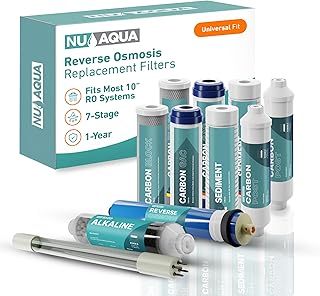
The NU Aqua set covers a 7-stage filtration sequence including sediment, carbon, RO membrane, alkaline remineralization, and UV. What separates it from the Express Water kit above is the inclusion of parts and fittings, which is a practical touch for anyone doing their first annual filter swap. The alkaline stage is worth understanding: RO membranes remove nearly everything, including beneficial minerals like calcium and magnesium. A remineralization filter adds some of those minerals back, which improves taste and brings pH closer to neutral from the slightly acidic output a membrane alone can produce.
With 352 reviews at 4.6 out of 5, this set has enough real-world feedback to be trustworthy. It markets itself as universal, meaning it is designed to fit a range of standard under-sink RO housings rather than being locked to one brand. That flexibility matters if your existing system is not from NU Aqua. The UV stage functions identically to the one in the Express Water set: germicidal UV-C light disrupts microbial DNA without adding chemicals or altering water chemistry downstream.
At $99.95, this kit costs roughly $38 less than the Express Water set while still covering the major filter types. The trade-off is four fewer filters (7 versus 11) and a smaller review base. For a household on municipal water with average sediment levels, the 7-stage approach is likely sufficient. For well water with higher particulate loads, the extra pre-filtration stages in the Express Water set may justify the premium.
CFS RODI 10" Replacement Filter Kit (Sediment, Carbon, DI Resin)

RODI stands for Reverse Osmosis Deionization. This kit adds a deionization (DI) stage after standard sediment and carbon pre-filters, targeting applications that need near-zero total dissolved solids. Reef aquariums are the primary use case: even trace amounts of phosphates, nitrates, and silicates can harm coral. The same purity requirements apply to laboratory equipment, certain hydroponics setups, and some photography and printing processes. If you are filtering water for drinking, this kit is more than you need and the DI resin is not cost-effective at household drinking water volumes.
The included resin is described as MBD-30 nuclear grade mixed-bed deionization resin. The color-indicating design is genuinely useful: the resin changes color as it becomes exhausted, so you know when to replace it rather than guessing based on a calendar interval. At 4.8 out of 5 across 92 reviews, this kit has a solid track record. The majority of those reviews come from aquarium hobbyists, which gives a clear picture of who this product actually serves well.
The sediment and carbon stages in this kit serve the same protective role they do in any RO system. The sediment cartridge removes physical particles that would clog downstream media. The carbon stage removes chlorine and chloramines that would degrade an RO membrane over time. The DI stage comes after the RO membrane and polishes the output further toward zero TDS. This is a specialized kit that scores well within its niche, but it is the wrong tool for standard kitchen drinking water filtration.
10 Micron 10" x 2.5" Sediment Filter, Whole House (Pack of 6)

Sediment filters are the most straightforward filter type: they are physical barriers that trap particles above a certain size. A 10-micron rating means this filter catches particles 10 micrometers and larger, which includes sand, silt, rust flakes, and most visible debris. It does nothing for dissolved contaminants, chemicals, bacteria, or viruses. Its job is purely mechanical. In any multi-stage system, the sediment filter goes first because it protects the more expensive downstream filters from physical clogging and premature failure.
This 10-micron version is sized for whole-house applications, fitting standard 10" x 2.5" housings and listed as compatible with Culligan, GE, and several other brands. Buying a six-pack at $21.99 works out to roughly $3.67 per cartridge, which is a reasonable price for whole-house pre-filtration. Sediment filters in a busy household or one on a well may need replacement every one to three months depending on sediment load, so having extras on hand prevents a trip to the hardware store in the middle of a replacement. The perfect 5.0 rating should be read with appropriate caution given only 23 reviews.
For well water users, sediment filtration is typically the first and most visible problem to address. Heavy iron, clay, or sand content can foul carbon and RO filters quickly without a proper sediment pre-filter in front of them. Our guide to well water filtration systems goes into more detail on sequencing these stages for high-sediment sources. On clean city water, the same cartridges may last considerably longer than the manufacturer's stated interval.
iSpring F3 6-Month Prefilter Set for Under-Sink and RO Systems

The iSpring F3 covers the pre-filter stages for a standard under-sink or RO system at a low per-year cost. At $17.43 for a 6-month set, the annual filter spend works out to roughly $35, which is among the more affordable options in this category. Pre-filters in an RO system typically include a sediment stage and one or two carbon stages. These protect the RO membrane from physical debris and chlorine respectively. Replacing them on schedule directly extends the working life of the membrane, which is usually the most expensive single component in the system.
iSpring is an established name in the home water filtration space with an active product line of under-sink and RO systems. The F3 is a pre-filter set specifically, meaning it does not include the RO membrane, post-carbon, or UV stages. If you need to replace only the pre-filter stages on a working RO system that otherwise performs well, this is a cost-effective way to do it. The 4.7/5 rating is solid in principle, but with only 2 reviews it carries essentially no statistical weight.
The 6-month service interval is realistic for most municipal water supplies with average sediment and chlorine levels. In households where the pre-filters appear visibly discolored after 3 to 4 months, shortening the replacement interval is the right call rather than waiting out the full 6 months. A clogged or exhausted pre-filter reduces water pressure reaching the RO membrane and accelerates membrane wear, making the pre-filter schedule more consequential than it might seem.
ICEPURE 1 Micron 2.5" x 10" CTO Carbon Sediment Filter (Pack of 4)

CTO stands for Chlorine, Taste, and Odor, which describes what carbon block filters are primarily designed to remove. This ICEPURE cartridge combines carbon block filtration with a 1-micron physical rating, which is considerably finer than the 10-micron sediment filter reviewed above. A 1-micron filter catches smaller particles including some cysts such as Cryptosporidium and Giardia, though this product listing does not carry a specific certification claim for that. The carbon block construction means filter media is densely packed, which slightly slows flow rate but increases contact time between water and carbon for more thorough adsorption.
Activated carbon works through adsorption: contaminant molecules adhere to the large surface area of the carbon material as water passes through. Carbon is effective at removing chlorine, chloramines, many volatile organic compounds (VOCs), and substances that cause taste and odor problems. It does not remove dissolved minerals, nitrates, fluoride, or most heavy metals. This ICEPURE cartridge handles both sediment and carbon roles simultaneously, which is useful in a system where housing positions are limited.
At $26.99 for a pack of four, the per-cartridge cost is about $6.75. The 1-micron rating means this filter will clog faster than a coarser sediment stage in water with significant particulate content. In practice, this works best as a second-stage filter positioned after a coarser sediment pre-filter rather than as the first stage. The compatibility list includes DuPont housings and standard RO unit sizing. With only 6 reviews, the 4.6 rating provides minimal confidence about long-term real-world performance.
Aquatic Life 10-Inch Sediment and Carbon Block RO Prefilter Kit
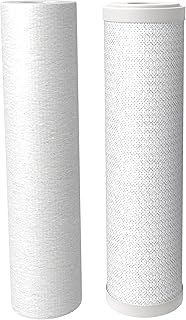
At $12.60, this is the most affordable kit in this roundup and covers the two most critical pre-filter stages for any RO system: sediment and carbon block. Sediment catches physical particles; carbon block removes chlorine and organics that degrade the RO membrane over time. Together, these two stages address the most common causes of premature membrane failure. If your full filter set change is coming up but your RO membrane was recently replaced and is still performing well, buying just the pre-filter stages like this set saves money without compromising the membrane's protection.
Aquatic Life is a brand with roots in the aquarium space, and this kit is positioned for both drinking water RO and aquarium RODI applications. With 81 reviews at 4.6 out of 5, this kit has the most balanced ratio of price to review confidence in the budget tier. The standard 10-inch sizing fits a wide range of housings. One limitation: the product listing does not specify micron ratings for either filter, which makes it harder to match precisely to a system that requires a specific particle rating.
This kit suits buyers who understand what pre-filters do and need affordable replacements on a regular schedule. It is not a complete filtration solution: you still need an RO membrane, post-carbon stage, and optionally a UV stage for a full system. Think of it as the consumable maintenance item for the first two housing positions in a multi-stage setup, not as a standalone solution for any contaminant problem.
Brondell RF-20 Sediment and Carbon Block Filter (Circle RO System)

The Brondell RF-20 is a proprietary replacement filter set for the Brondell Circle under-sink RO system. It covers sediment and carbon block pre-filtration with a 6-month service life. If you own a Brondell Circle, this is the correct replacement filter with guaranteed compatibility; there is no meaningful alternative to consider. If you do not own a Brondell Circle, this product is not relevant to your system and you should look at the universal-format options reviewed above.
At $79.99 for sediment and carbon block pre-filtration only, with no RO membrane, no UV, and no post-carbon included, this is significantly more expensive per stage than equivalent filtration in standard-format filter sets. That price gap is a consistent feature of proprietary filter systems: the housing is often sold at a lower initial margin, and the manufacturer recaptures that margin on replacement cartridges. Factor this into your total cost of ownership when comparing RO systems at the point of purchase, not after.
With only one review and a 4.5/5 rating, there is essentially no usable crowd-sourced reliability data here. The score of 7.0 reflects that the product does what it claims for its intended system, but the proprietary lock-in and high per-stage cost relative to universal alternatives make this a situational necessity rather than a positive choice. Brondell makes well-regarded products overall, but this filter set is worth the price only if you already own the Circle system and need to keep it running.
How to Match Filter Types to Your Actual Water Problem
Understand What Each Filter Type Actually Removes
Sediment filters handle physical particles: sand, silt, rust, and debris above their rated micron size. They do nothing for chemicals or microbes. Activated carbon filters remove chlorine, chloramines, VOCs, and substances that affect taste and smell through a process called adsorption, where contaminant molecules bond to the surface of the carbon material. They do not meaningfully reduce dissolved minerals, nitrates, fluoride, or most heavy metals. Reverse osmosis membranes reject a broad range of dissolved contaminants including lead, arsenic, fluoride, nitrates, and most pathogens by forcing water through a semi-permeable membrane with pores around 0.0001 microns. UV filters use ultraviolet light to disrupt microbial DNA, neutralizing bacteria, viruses, and protozoa without adding chemicals. No single filter type handles everything, which is why multi-stage systems combine them.
Match Your Filter Stages to Your Water Source
Municipal water is typically already disinfected and low in sediment, so carbon filtration for chlorine removal and an RO membrane for dissolved solids often suffices. Well water is a different situation: it may contain iron, manganese, hydrogen sulfide, bacteria, sediment, and heavy metals depending on local geology. A well water system usually needs sediment pre-filtration, iron-specific treatment, carbon stages, and UV disinfection at minimum. Our well water filtration guide covers the sequencing in more detail. If you are on a private well and unsure of your water chemistry, a certified lab test is the only reliable starting point before buying any filter system.
Filter Order Matters More Than Most Buyers Realize
In a multi-stage system, the sequence is not arbitrary. Sediment always comes first to protect downstream filters from physical clogging. Carbon stages follow to remove chlorine before it reaches the RO membrane, since chlorine degrades thin-film composite membranes over time. The RO membrane comes next, handling dissolved contaminants. Post-carbon or alkaline remineralization follows the membrane to improve taste and pH. UV, if present, typically comes last so it treats water just before it exits the tap, ensuring nothing recontaminates after the membrane. Buying a matched filter set like the Express Water or NU Aqua kits handles this sequencing automatically and removes the risk of stage mismatch.
Micron Ratings and What They Tell You
A micron rating tells you the smallest particle a filter will capture. A 10-micron sediment filter catches particles 10 micrometers and larger, including most sand and larger silt. A 5-micron filter is finer, catching medium silt. A 1-micron filter catches smaller particles including some cysts. The ICEPURE CTO filter reviewed above is rated at 1 micron, making it more protective than a standard 10-micron filter but also more prone to clogging faster in water with high particulate content. In practice, pairing a coarser first-stage sediment filter with a finer carbon block second stage gives you both protection and extended filter life. For a broader look at how to sequence all of these choices, see our home water filtration buyer's guide.
Factor in Replacement Cost, Not Just the Purchase Price
The upfront cost of a filter set is only part of the picture. A system that uses proprietary cartridges like the Brondell Circle may have a lower initial hardware price but significantly higher ongoing filter costs. Standard 10-inch format filters are available from multiple brands at competitive prices, which is why they appear across most of the products in this roundup. Calculate your annual filter cost by dividing the cartridge price by the rated service life in months and multiplying by 12. For a well-water household running high sediment loads, sediment filters may need replacement every 4 to 6 weeks rather than the manufacturer's standard 3-month interval. Building that into your estimate before purchase prevents surprises later.
Frequently Asked Questions
Not necessarily. Most households on city water get good results from carbon filtration for chlorine and taste, with an RO membrane added if dissolved contaminants like lead or nitrates are a concern. UV becomes relevant if your water may contain bacteria or viruses, which is more common with private wells or areas with aging distribution systems. Sediment filtration is worth adding if your water is visibly cloudy, you are on a well, or you notice filters clogging quickly. A water test from a certified lab gives you the clearest picture of what you actually need.
Activated carbon removes chlorine, chloramines, VOCs, and taste and odor compounds effectively, but it does not meaningfully reduce dissolved minerals, fluoride, nitrates, lead, arsenic, or most heavy metals. An RO membrane physically rejects most dissolved contaminants by forcing water through extremely fine pores, including the things carbon misses. The two technologies are complementary: carbon pre-filtration protects the RO membrane from chlorine degradation, and the RO membrane handles the dissolved contaminants carbon cannot address.
The standard recommendation is every 3 to 6 months for most household applications, but the actual interval depends entirely on your water's sediment load. On well water with visible particulates, monthly replacement is sometimes necessary. On clean municipal water, a sediment cartridge might last 6 months or longer. A reliable indicator is a noticeable drop in water flow pressure, which signals the cartridge is clogged. Inspect the cartridge color when you do replace it; a heavily discolored filter that was recently installed means your interval needs to be shorter.
UV disinfection requires clear water to function properly. Turbid or high-sediment water allows particles to shield microorganisms from the UV light, reducing its effectiveness significantly. In practice, UV stages always follow sediment and carbon pre-filtration to ensure clear water reaches the UV lamp. A UV stage alone will not remove chemicals, sediment, or dissolved contaminants; it only neutralizes living microorganisms. It is always the last stage in a sequence, not a standalone solution.
GAC (Granular Activated Carbon) uses loose carbon granules. Water flows through the gaps between the granules and contacts the carbon surface. Carbon block filters compact the carbon into a solid matrix, forcing water to flow directly through the material rather than around it. Carbon block provides longer contact time with the water, which generally improves chlorine and organic removal. Carbon block also provides a physical filtration function, catching particles above its rated micron size. GAC tends to flow faster but is slightly less thorough. Most multi-stage RO systems use both: GAC as a first carbon stage and carbon block as a finer second stage before the RO membrane.